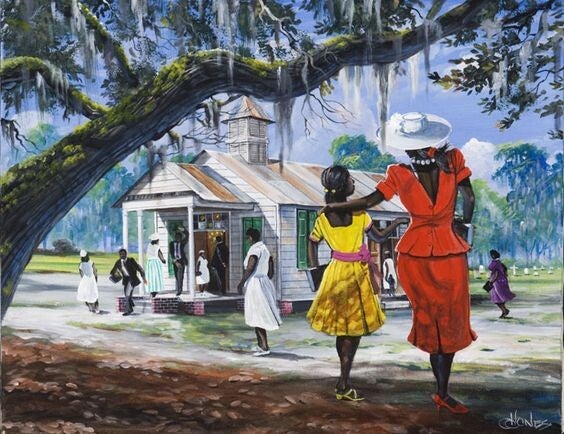
Here we tackle this question not as a discursive thought experiment, but as a practical exposition meant to give context to an already evolving question.
The Oxford-English Dictionary traces the origins of the ethnonym African American as far back as 1835, but scholars have found its usage in a sermon titled “A Sermon on the Capture of Cornwallis” from 1782. The sermon discusses the need for African Americans—then enslaved—to fight for liberty against the British monarchy to gain American independence. It is debated but unproven that this sermon was written by an African American, though it is noted that its audience consisted of Americans of African descent, namely those identified as slaves at the conception of American ideology.
We begin with this exposition not to belabor the point of discussion, but to provide an origin for the term—or ethnonym—that later became popularized in the 1980s when Jesse Jackson promoted it as an alternative to Black.
For African Americans, or American Descendants of Slavery, this delineation is significant and carries with it a lineage of trauma: centuries of dehumanizing abuse and domestic terror, psychological torture, and violence that includes lynching, castration, rape, and inhumane medical experimentation. Pseudoscientific reasoning was used to justify these atrocities, reasoning later echoed in the justifications for the crimes committed against Jewish people during World War II. In contrast, the term also denotes a profound and often overshadowed resilience—hope, spirit, and willpower—that fueled the fight for human and civil rights and resonated on a global scale, even serving as inspiration for South Africa’s struggle against apartheid.
The question of what it means to be African American does not exclude the origin story, but it also does not turn that story into a mythological weaving of dreams untethered from reality. It is a standalone historical narrative of redemption, akin to that of the Israelites in the New Testament of the Bible—a book that was illegal for slaves to read and whose possession often resulted in severe punishment or death, yet one that became a foundation for spiritual salvation and liberation from the plantations to which they were bound.

E. Francis White writes, “The African past lies camouflaged in the collective African American memory, transformed by the Middle Passage, sharecropping, industrialization, and urbanization. Few material goods from Africa survived this difficult history, but Africans brought with them a memory of how social relations should be constructed that has affected African American culture to the present.” African Americans, or American Descendants of the institution of slavery, are not Africans in America—they are American. The ties that once bound them to African origins were transformed by, as White notes, “the Middle Passage, sharecropping, industrialization, and urbanization.” Within the chasm between past and present also lie the Jim Crow and Civil Rights eras, convict leasing, mass incarceration, drug proliferation, and the pathological disenfranchisement imposed by broader American society. African American identity is not situated in Africa. It stands alone, supported by a culture created as an inferiorized, indigenized, and ornamentalized people in the land of the free and the home of the brave.
In her essay “Africa on My Mind: Gender, Counterdiscourse, and African American Nationalism,” E. Francis White offers the idea that “although the impact of these African roots is difficult to assess, few historians today deny the importance of this past to African American culture.” She explains that her work examines how African Americans in the late twentieth century construct and reconstruct collective political memories of African culture to form a cohesive group capable of shielding itself from racist ideology and oppression. While the focus of her essay differs from that of this paper, her introduction reinforces the foundation of this exposition: African American identity is not rooted in Africa. The ways in which American Descendants of the institution of slavery construct political memory, cultural identity, and selfhood are not based on a nonexistent African sensibility, but on their foundational role in American history.
The question of what it means to be African American is not answered by retracing steps to determine which tribe sold whom to which part of the world, but by identifying which slave ship carried one’s ancestors to the shores of the country they built with their blood, sweat, and tears. It is answered by the plantation to which they were chained and the length of time before emancipation. It is answered not by a Pan-African dream, but by factual accounts of life on American soil before freedom was legally recognized. Few historians today deny the importance of the African past to African American culture, but we also recognize that this collective memory was transformed by the Middle Passage—one that uprooted the necessity of justifying an African identity and instead forced the construction of an American one.
What it means to be African American for the American Descendant of the Institution of Slavery is the same as asking, What does it mean to be American? They are the same question, merely worded differently.
References:
https://yalealumnimagazine.org/articles/4216-the-origin-of-african-american
https://iiif.lib.harvard.edu/manifests/view/drs:50845864$1i
Montmarquet, J. A., & Hardy, W. H. (2000). Reflections An Anthology of African American Philosophy. http://ci.nii.ac.jp/ncid/BA65356223
Photo Credits:
https://www.ebay.com/itm/393430882533 (Arthur Dawson - ATTENDING CHURCH)
https://www.blacksouthernbelle.com/12-pieces-of-african-american-church-art-we-love/ (John Jones - Black Southern Belle)
Add comment
Comments